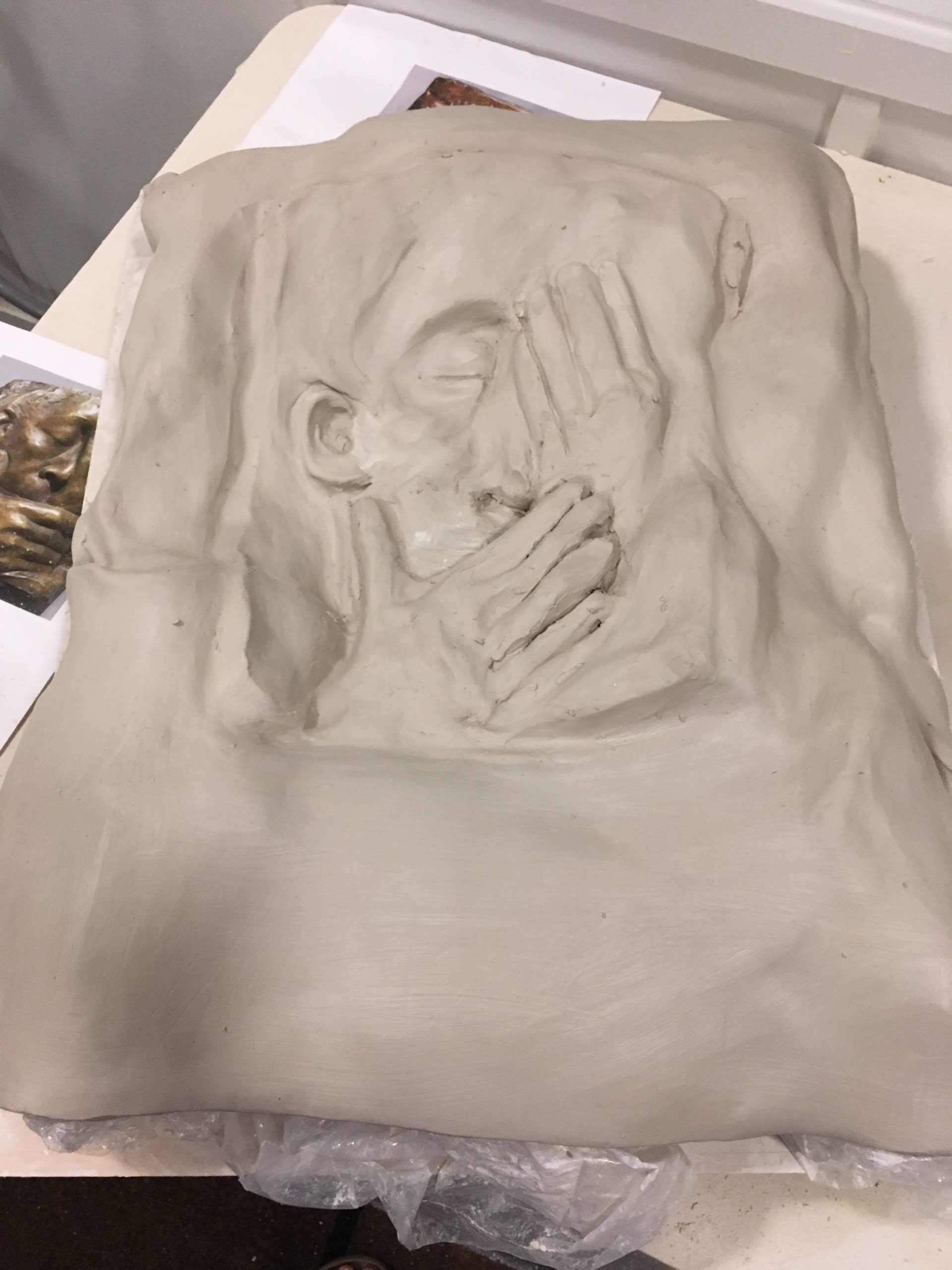
Rachel’s Perpetual Pillow
- 2016, Glazed porcelain with acrylic
- 6 1/2” x 20” x 17”


Catalog Entry from If These Walls Could Talk Exhibit, Neill-Cochran House 2020:
In 2016 several policemen were shot and killed in Dallas. This tragedy hit close to home. President Obama gave a moving address at a memorial service for the officers. It was not time “to let the healing begin,” as our country had been rushed into so many times before. It was a time to mourn. The Jewish matriarch Rachel came to mind, Rachel who could NOT be consoled after the deaths of her children (Jeremiah 31:15) One of the most articulate artists of grief is Käthe Kollwitz, a German artist who chronicled the suffering of World War I. Her self-portrait image entitled Lament, a relief sculpture in bronze, provided me with the basis for a pillow. Modeling the clay into Kollwitz’s sorrowful visage, I thought of her weeping into her pillow. Years ago I made a bed pillow for Jacob, the patriarch who used a stone for a pillow. Jacob’s encounter with the wrestling angel made me think he deserved a nice soft squishy pillow later in life, so I titled it Jacob’s Latter Pillow (see No. 33), a slight pun, since the story is often called “Jacob’s Ladder,” because he sees a ladder of angels climbing to the heavens. Jacob was married to Rachel after a deceptive father-in-law tricked him into first marrying her sister, Leah. So it seemed fitting that the couple would at last have a pair of matching bed pillows. However, Rachel’s pillow turned out to be a bulky, heavy sort of pillow, unlike the light-hearted one I’d made for Jacob. Maybe instead of feathers, hers was of memory foam. She could not help but remember her own tragedy. We tried the two pillows together on one bed, but they seemed to need their own space, hence they have separate bedrooms. It was lovely to see how they blended in with the coverlets the museum already provided for those beds. This all-white sculpture also represents a warning that most of us white women are unaware of: that white women’s tears in cross-racial interactions are problematic. I was glad to learn this right before visiting the heart-rending National Memorial for Peace and Justice (the “lynching memorial”) in Montgomery. Due to the historical backdrop of black men being tortured and murdered because of a white woman’s distress, our tears may trigger that terrorism. Additionally they divert attention to the crying woman while those of color are overlooked. (see White Fragility)
Backstory Gallery