Polarities
- 2016, Glazed porcelain with gold and white gold, in 11 parts.
- installed app. 9 3/4 “ x 17” x 36” white can: 9” x 7 3/4” dia. black can: 9 3/4” x 7 1/2” dia. Pollock: 3” x 17” x 20”
Catalog Entry from If These Walls Could Talk Exhibit, Neill-Cochran House 2020:
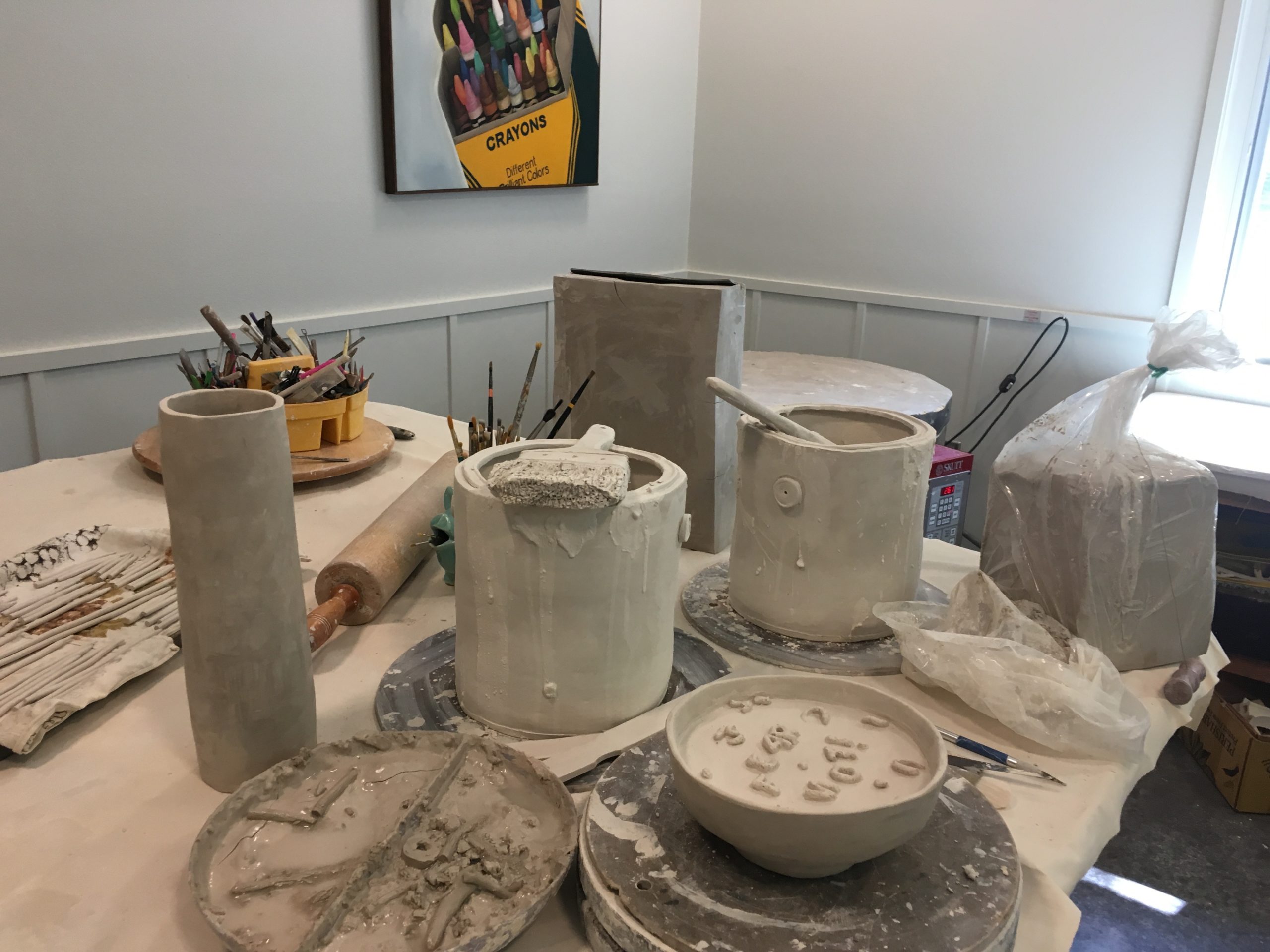
Cans of paint were part of our existence as we remodeled our house recently. The artist’s standard encouragement to “start where you are” was as good advice as any for me. Looking at what else was going on at that time—well it was the presidential campaign season of 2016. Some of the buzzwords of the campaign season were “broad brush,” “polarization” and “mud slinging.” Mud slinging, in a productive way, is what potters do. Paint slinging, a wasteful happy-go-lucky gesture… well, that led to Jackson Pollock and his mess of house paint. A tableau of porcelain paint cans, wide brushes, and a paint-daubed drop cloth came into my mind. Attempting to reproduce a Pollock painting, however, is ridiculous. There is no way on God’s green earth that one can render his swirls and twirls of paint the way he did. Films of Pollock in action help us understand this—he’s in Shiva dance mode. First I textured a big slab of clay with an actual canvas drop cloth. It seemed odd, like a remnant, but I learned that Pollock used scraps of canvas in some of his paintings, too. “Remnant” is a symbolic term in the Bible, for the most part referring to Israel as the chosen people, but the word is also used with a negative meaning to point at what is left following judgment. In Isaiah, the remnant carries hope of restoration. In Romans, there is a remnant chosen by grace. Richard Rohr reminds us that Christianity was always intended by Jesus to be a minority position. He wasn’t dividing the world into those God loved and those God didn’t love. Jesus was creating a remnant that was usable by God to keep the whole world from its violent path toward self-destruction.36 Mimicking Pollock’s massive painting Blue Poles, I borrowed eight blue pickup sticks from my previous porcelain piece (Chlora’s Pick up Sticks, No. 62) and placed them on my clay canvas. What fun to squirt and drip and trail several layers of the glazes until the surface was thick and textured! I had to buy some new 3D glaze products, as typical underglazes have only slight texture. To finish off the two paint cans, I searched for adaptations in art history and vintage paint brands for images. The Benjamin Moore Company, once produced a house paint called MOORGARD-- Moor, as in the mixed breed of Muslims from the 8th to 12th centuries primarily in North Africa. Another lively paint brand of the 1950s-70s was Red Devil, a term that applies to several military units and devices. The labels also suggested conflict, so then I wanted battle scenes on the cans. I narrowed my art history search to wars between races. The best battle turned out to be one depicted by Piero della Francesca, his Victory of Constantine over Maxentius. As the first of the “onward Christian soldiers,” Constantine would be the king of one of the paint cans. In this scene from Piero’s fresco cycle, Constantine beat his rival for Roman emperor, Maxentius, in the famous Battle of the Milvian Bridge in 312. In 2013 I visited Rome where a friend drove us over that still-existing bridge, pointed to the ratty marshlands, and said, “This is where Christianity began…” Really? Christianity began on a battlefield? Drain the swamp? Pollock might be appalled that I find his paintings exemplary of both prophetic criticism and prophetic energizing. They show what our reality is—a hodgepodge of involvements that can’t be easily separated—and they also bring out the beauty of that muddle. They remind us that a new global myth, a meta-story of interconnectivity, is developing, like it or not. We can see that interconnectedness forms the basis of economics, health and ecology. Here in the slave Dependency, Jennifer quickly saw the multicolored mass in the middle as the place we need to be. When she was producing a film about the Neill-Cochran house and Dependency, black actors in 19th-century attire came in and out carrying lumber and paint cans. They were portraying the enslaved workers who built this place. So, Polarities is a small acknowledgement of them.