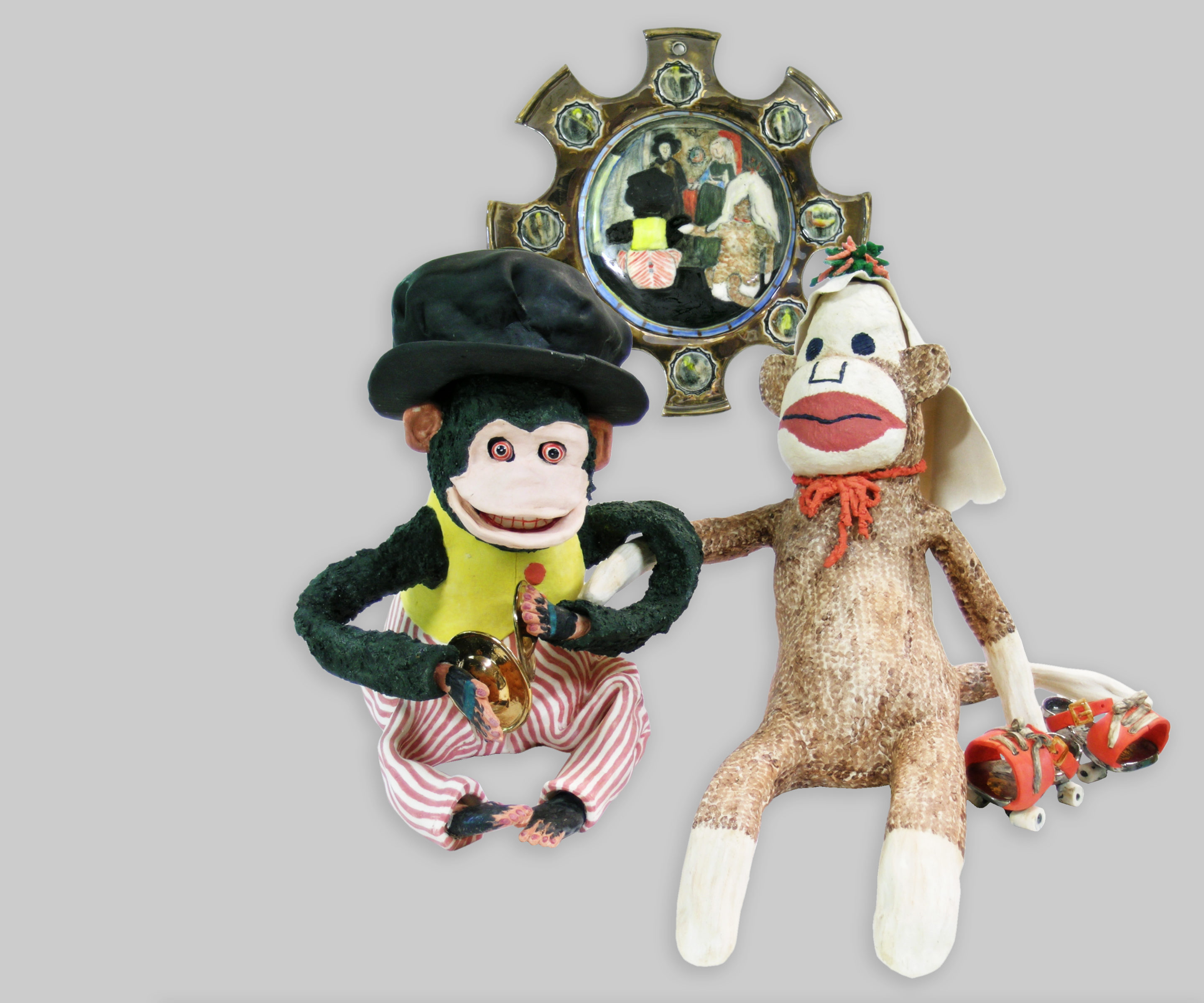
Monkey Mind Marriage
- 1997, Glazed porcelain with gold and white gold, in 11 parts.
- 12" x 20" x 12 1/4" installed
- Available for Sale
Catalog Entry from If These Walls Could Talk Exhibit, Neill-Cochran House 2020:
If you are offended by this piece, you are in good company. It is installed here for the purpose of facing up to the fact that many “dog whistles” are unrecognized by those for whom they are not intended. When Jennifer saw a photo of my monkeys, she shuddered and challenged me to realize that these toys have racial overtones, especially the circus monkey. I had not made that connection, as I like monkeys and have never associated black people with them, even though our prejudiced culture does. She was as startled by my obliviousness as I was startled by her assertion. Our differences became a case in point: we need to talk about these things. So we agreed to include Monkey Mind Marriage in the exhibition as a “courageous conversation starter.” When does white privilege ignore hurtful overtones, and are blacks overly sensitive? If a white stranger called your baby “a cute little monkey,” you would balk, too. We must pay attention to micro-aggressions. This piece was made in 1997, as a joyful celebration of our wedding anniversary. This is what I wrote then: “The two monkeys here are quite different. They are modeled after toys my husband and I each had when we married. His, the extroverted monkey, used to wind up and clang his cymbals, straight out of I Corinthians 1:13; mine was made somewhere in the Ozarks out of an old, introverted sock.” The marriage referred to is Jan Van Eyck’s Arnolfini Portrait. Like many icons of art history, the painting’s symbolism has been dissected and contested. Here, “Arnold and Feeney” wear their 15th-century headgear. Both are barefoot. Either they’re on holy ground or are about to play footsie; after all, this isn’t Mt. Sinai. One art historian argues that the whole painting is about the trap of marriage, so in my scene Feeney’s red shoes have become roller skates to give her mobility (however, the skates are also a tribute to my painting professor, Donald Roller Wilson, who paints superb monkeys). “Monkey mind” is also a disputed term. In Eastern meditation, it is defined as an interior whirl or clutter of endless and aggravating alternative thoughts that hamper one’s ability to focus. I prefer the more positive connotation, that monkey mind is a highly creative form of non-linear thinking which swings from one idea to another, making connections between them. A marriage of submission and blind obedience, indicated in Van Eyck’s careful hand gestures, is unlikely to be creative or mutually supportive. So instead, this bride and groom interlink their entire arms.”