
Ministry of Absorption
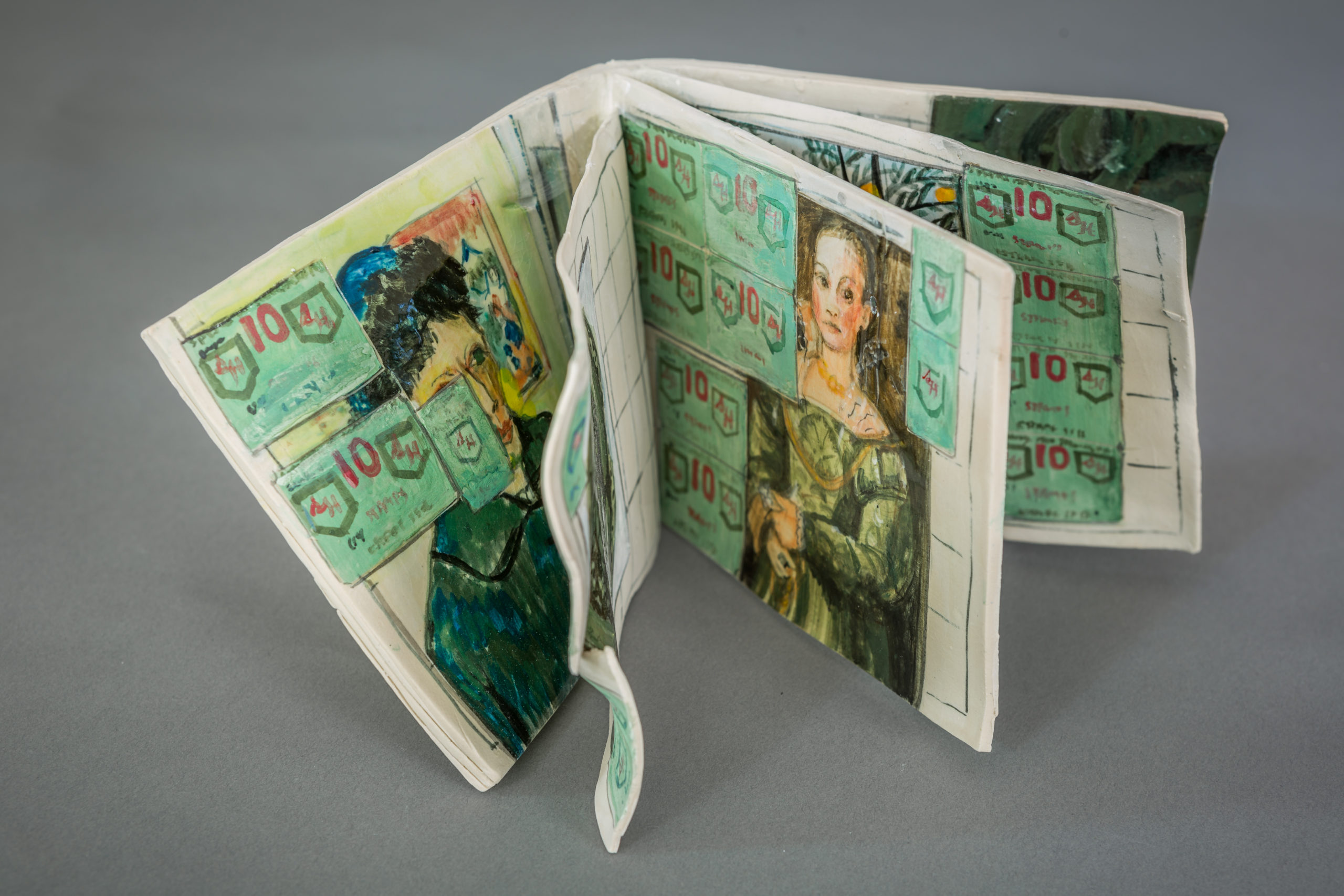
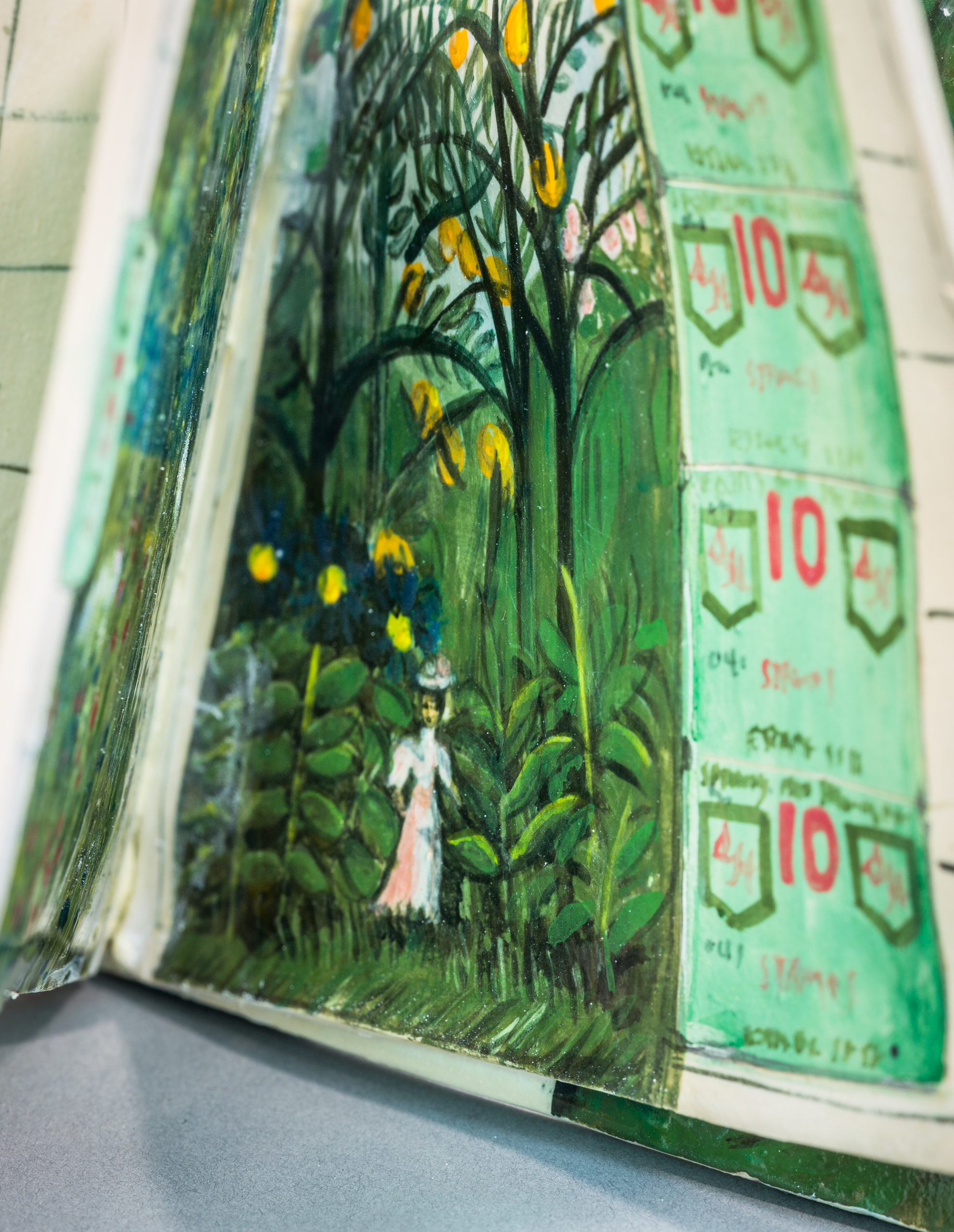
- 2016, Glazed porcelain with acrylic, 4 parts
- Installed app. 4 1/4” x 26” x 20”
- Available for Sale





Catalog Entry from If These Walls Could Talk Exhibit, Neill-Cochran House 2020:
In a junk store I found a booklet of Green Stamps, dating from the early 1970s, I think, due to its graphic design. Nostalgia set in. My sisters and I used to glue those innumerable stamps into Saver booklets for Mom, and were rewarded with a selection of something wonderful at the Redemption Center. That is, unless it all went toward a new blender or something useful. The key to getting Green Stamps to stick was a large kitchen sponge. If you could swipe an entire sheet of the stamps in one wet swoop, a page could be filled immediately. That sponge got quite a workout. The booklets turned into a soggy, swollen mess, but they dried out into crispy, crooked pages. Sooner or later. Mom took a bagful of pasted booklets into the Redemption Center where some sales lady had to flip through them to make sure all the pages were filled. Hence, my Chlora character spied a flaw in the system: the salesladies in their haste just glanced at the pages; if they were green, they were good. So Chlora stuck green paintings in there., i.e., she cheated. I had as much fun as Chlora did locating all-green paintings. That was the only criterion. Like other colors, green has widespread symbolism. Primarily it is seen as the color of new growth, spring, hope. It would be good to show some diversity in my design, so I found 22 mostly European landscapes, some Chinese and pre-Columbian jade, an Irish bell shrine, and an Iranian glazed dish. The only picture that had religious significance was Paul Gauguin’s Green Christ, a painting he made of a stone signpost of the Pietà. That particular subject, the dead Christ, on a sponge, meant something. I’d surmised that Christ’s descent into hell was perhaps an act of taking on not only the sins but also the wounds of the world; that Christ performed this visitation down below over and over again, took on that burden in his very body, and then submitted himself to torture to be rid of it. Later I read that the Crucifixion itself could be read as a ministry of absorption- -an act of non-violence, the absorption of hate in order to halt the cycle of violence. In our time, non-violence is associated with the Rev. Martin Luther King, Jr., and with Gandhi. Think of all the oppression and indignities that African- Americans have endured in order to keep the peace…their decades of absorption go back to 1619 when that first slave ship arrived from Africa.