Earth is the Lord’s Footstool
- 1997, Glazed porcelain with acrylic
- 9" x 11 3/4" x 15"
- Available for Sale
Catalog Entry from If These Walls Could Talk Exhibit, Neill-Cochran House 2020:
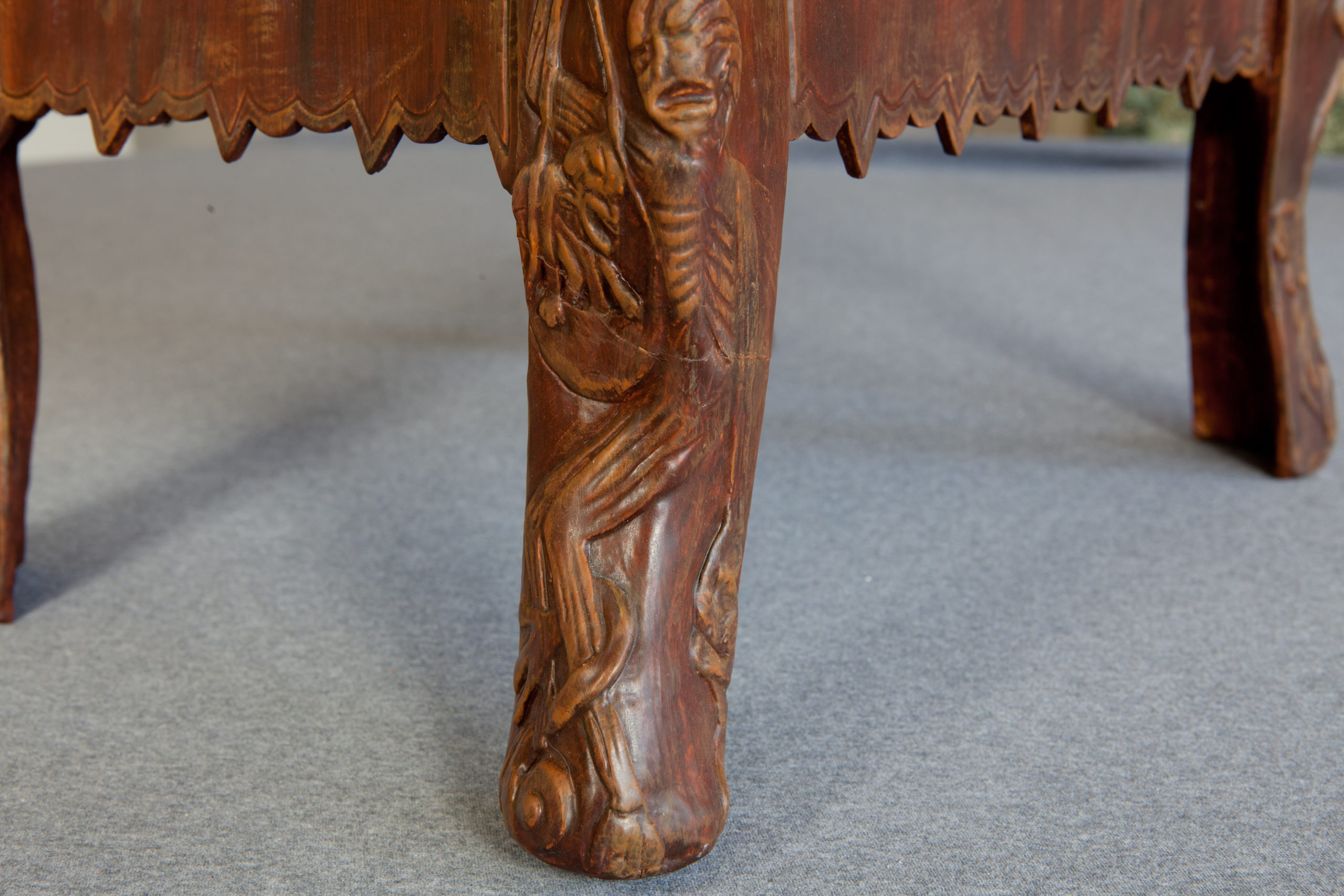
Underworld images of the damned, as carved into the footstool’s legs. Nobody did hell better than the French Romanesque. Early Christian images of God were majestic but often severe. Enthroned Majestas Domini show a mean, vindictive being whose main job was judgment and damnation. Knowledge of the world was confined to a literal interpretation of Scripture, which obliterated the more advanced cartography of the ancient Greeks and Romans. The medieval universe consisted of only three continents, according to the repopulation of the earth after the great flood. Noah’s youngest son Ham, who saw the nakedness of his father, was cursed and condemned to slavery, and relegated to the continent of Africa... hence the horrible rationalization for enslavement of Africans over the centuries. In medieval times, space was a modified metaphor, with the Holy Land enlarged and oriented to the east. Early medieval maps drawn in the simple “T-0” configuration held onto this geography, and by the 13th century more elaborate, encyclopedic maps called mappaemundi (“cloth of the world”) detailed Biblical places and events. Large ones such as the Ebstorf Map were fine works of art that served as altarpieces. My pastiche of the Ebstorf Map and the “T-O” maps is glazed on top of the footstool. Here the head, hands, and feet of Christ surround the then-known world. It was Christ’s body, with Jerusalem as his navel. On the footstool’s legs are adaptations of four carvings from Autun Cathedral, where a full panoply of scenes served as a visual catalog of sin and punishment. Here, two legs show the weighing of souls, and another leg depicts The Mouth of Hell, a trapdoor sea monster who chews up the naked damned and swallows them into the fiery pit. The fourth leg shows demonic fingers plucking off a sinner’s head. R-rated for violence and nudity, this public art. It makes you wonder what psychological and spiritual damage has accumulated over the centuries from such teachings, and how much of it we still carry. (Artist’s notes from 1997)